Showing posts with label Chinese history. Show all posts

Saturday, March 15, 2025

Book Review: 'The Last Chinese Chef', by Nicole Mones


How do you distill the culinary essence of 5000 years of history into a single short book?

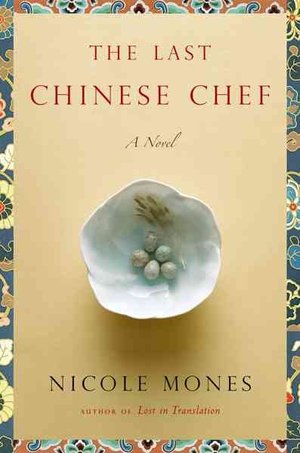
<= Kinda like this. Note the cover blurb by Ruch Reichl- which at the time was shorthand for people in food media to take the book somewhat seriously, and to help goad dabblers into a purchase. (The other cover, seen below, is better.)

The Last Chinese Chef is one of those books where even if you don't know a thing about the subject matter to start, you will by the end. Moreso, you'll likely be grateful for it. The more you know to start with though, the better you'll probably like it. I'm definitely a fan of this approach, which the book handles well- I would recommend it to anyone who has a care for the relationship between food and culture, food and family, or food and more food! In that way it's a lot like a Fuschia Dunlop book, which makes perfect sense given both the subject matter and the intended perspectives.

Written by Nicole Mones, who also penned Lost In Translation (you may have seen the movie adaptation, and if not you should- it's not the easiest watch but Bill Murray gives a truly inspired performance), it weaves the story of a food writer and a great chef into an already bright tapestry of Chinese literature, art, culture, and food.

Much of the main story is outlined by parables and Chinese idioms which serve to flesh out the story, making it seem a liiiittle less thin than it would otherwise read. While I noticed, knowing full well who this book was marketed at, not everyone will notice or even care. There are a fair number of interesting coincidences in the book too, but that's just... sort of how literature works in settings like Hong Kong, Taiwan, and China anyway. It's really hard to break out of that whole 'Asian Mystique' trope, I've found.
This manuscript also bears a lot of underlying resemblance to Jennifer Lee's "The Fortune Cookie Chronicles", which I'll post a review for sometime this week. Not in execution of course, but rather in intent. Serving not only to educate, but to illuminate and fascinate the reader. It reveals answers to questions you might not know you had, and subtly brings out the desire to explore further even as it does.

There's one fairly robust caveat to the book though. It was published in 2007, and the story's then too- in the period leading up to the 2008 Beijing Olympic Games. Using that context, the story fits superbly- the journey of a chef alongside the journey of his homeland, both seeking greatness, belonging, and approval as what they were and what they strive to be. The deliberate time and place setting serves to highlight the past, analyze the present, and inspire hope for things yet to come. It was a superbly chosen parallel at the time, but looking at it now? The messages ring hollow indeed.

In spite of that one bit of bother, this book is well worth a read. It might be indirect in its messages, but they could never be called vague. Chinese style, by a non-Chinese.

And that's the point, really. Read it- you'll see what I mean.

Monday, November 20, 2023

Book Review: "Invitation to a Banquet", by Fuchsia Dunlop


I've mentioned before that in the pursuit of knowledge, prejudice goes in all directions. Now as then as always, the notion of 'authenticity' has done great and lasting harm to earnest effort and serious scholarship for no other reason than look, mien, or pedigree. It takes some aggressively enthusiastic commitment and dedication to aspiring scholarship and understanding to adequately deflect or overwhelm those biases- coming from those one might seek to teach as much or more as from those one might seek to learn from.

Which is where we run into people like me, who hunker down and do the work while being too poor to go anywhere or do anything but read and research. We also run into people like Fuchsia Dunlop, who dived into the deep end of the practical application side. Her work and efforts are quite familiar to me, and have been for many years- just a day or two ago I put up a review of her 2009 memoir to prime the pump, as it were, for this. 

As a writer, her style is shaped by her study- deeply layered with information in a manner like unto poetry, and very much designed to be as informative as possible in accordance with the level of understanding possessed by the reader. A (non-Chinese) layperson would read this book and learn vast amounts; a mainland Chinese citizen layperson would read it and learn no less, but different things at different levels due to cultural background osmosis; I myself smiled as I turned the pages, knowing full well many of the potential battles involved in being the Token White Person trying to be taken seriously as a well-informed professional in certain matters of Asia. 

The sections of the book are simple enough, with a Prologue, Origins, Ingredients, Techniques, Ideas, and an Epilogue. Clever structuring of subsections, however, is what places Invitation to a Banquet on a pedestal of excellence. Each one uses as its framing structure a different given dish from Chinese culinary history. This in itself is a cleverly complex decision, emphasizing the notion of layered levels of understanding. Whether it's simply recipes, or branching out to histories, art and culture, agriculture, or more notions besides, the chapters do a fantastic job of sharing the essential while opening many diverse windows of opportunity to explore further, and it does so with fluidity and grace. 

While that was a fine self-evident success, a historical analysis also came to mind, and I considered how component parts of the manuscript might have worked as examples of the classical Chinese 'Eight-Legged Essay' format. (I cannot see those words without recalling the class I first learned the term in, and a friend's idle drawing of a pile of grouchy looking pages with spider legs.) I'm still thinking about it, and may yet have thoughts on it, but that's too much for now- that will come in a more in-depth analysis at a later date.

Not only is the manuscript extraordinary, but her bibliography and acknowledgement sections are similarly stellar. Scads of sources in both English and Chinese, historical translations, modern works, familiar and uncommon alike. Then comes the massive list of persons from all parts of the world and all walks of life that helped make her, and thence this book, more clever and comprehensively complete.

Of all Fuchsia's books, this serves best of them all as either an introduction or a capstone. 

Read it with relish. Then read it again, and see how much more you learn!